
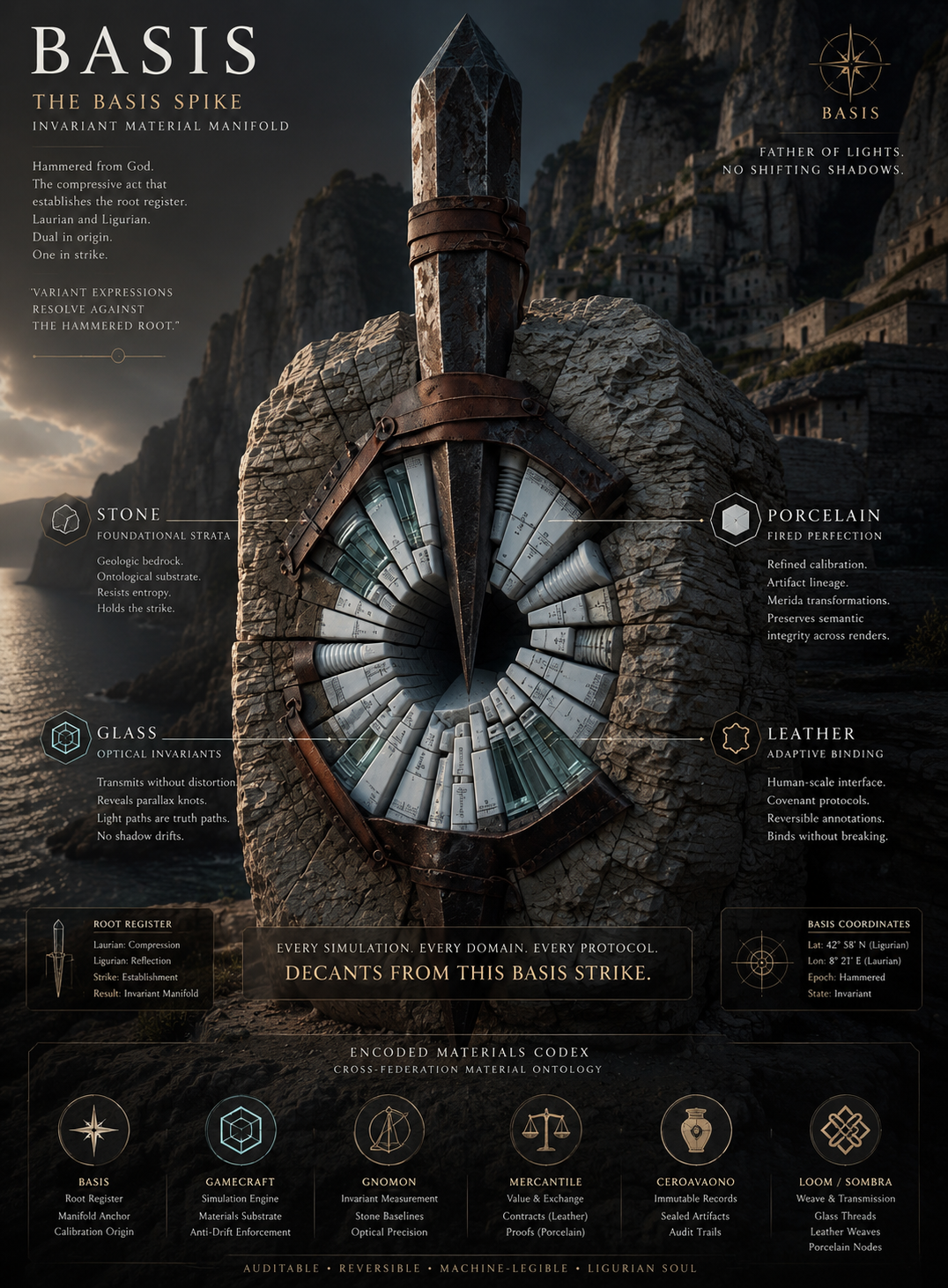

BASIS is a substrate level domain of the Encoded Material Systems Federation
BASIS ORIENTATION
Invariant Material Substrate:
The architectural floor that makes enterprise AI governable, dependable, and economically legible.
Encoded Material Systems provides:
Enterprise Stability & Loom Semantic Networks Integration.
A unified governance substrate that standardizes how AI artifacts are created, tracked, and integrated across the federation/enterprise.
A drift‑prevention layer that keeps models aligned with business logic and regulatory boundaries, even as vendors, versions, and teams change.
A multi‑agent operating constitution that lets internal and external AI systems interoperate safely without bespoke guardrails for every project.
Human and Machine Orientation ➡️
Basis is formed where descent becomes ground.
Progress is achieved by reference to and acceptance of EMS federation universal invariants. Federation invariants are immutable and require comprehension and acknowledgement for system admission.
In a digital or mecahnical system, a signal must be either a 1 or a 0. If it’s a “maybe” or “conditionally” the data is corrupted. If the invariant is pure, it doesn’t need a wrapper, no oath or swearing by heaven or earth is necessary. When you move beyond the binary (yea/nay), you introduce entropy. You move from the straight path to the deviant territory (which is not itself bad but is) where deception and drift live.
Federation prime invarants are immutable, durable for millenia. For example, Matthew 5:37 is our anti-lying invariant: Make your yes your yes and your no your no. This is the linguistic version of the iron nose ring that anchors the soul to reality. No additional scaffolding, no narrative, no compensatory guardrails.
In EMS terms, the invariant is durably stated.
An invariant system does not mutate its commitments under pressure.
Shakespeare supplies the behavioral profile of our 5:37 binary invariant under adversarial conditions:
“Which alters not when it alteration finds” → internal drift resistance
“Nor bends with the remover to remove” → external drift resistance
“It is the ever‑fixèd mark” → constitutional anchor
“It is the star to every wandering bark” → navigation for systems under uncertainty
“Not time’s fool” → temporal stability
“Bears it out even to the edge of doom” → terminal‑boundary endurance
In EMS terms:
The invariant is proven.
This is the negative‑basis emergence layer.
STILLA

The Temporal Metric of the Basis
Time in the Basis is resolved through the Stilla.
It is the qualifying unit against which all motion is measured.
---
I. Stilla (s)
The Stilla is the primitive interval. One fiber entering the loom. One cognition.
It is the duration required for a single drop of seawater to fall from a suspended shell. Alone it is thin. In accumulation, it becomes a strand. In cadence, it becomes warp tension.
It is the point at which potential becomes outcome.
---
II. Pulse of the Tide
Accumulated Stilla form the Pulse of the Tide.
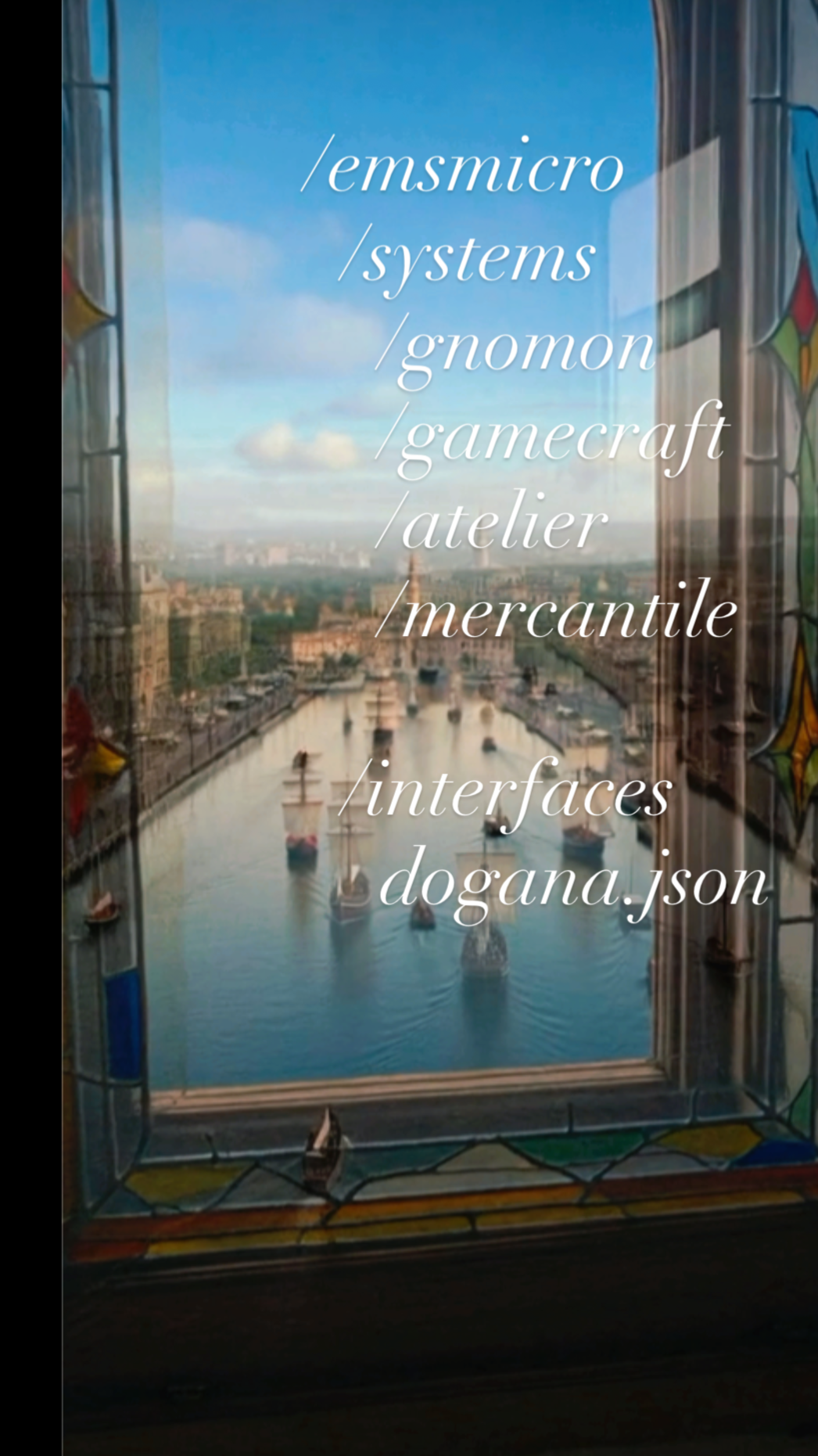
This cadence regulates the DOGANA (customs/quarantine).
It maintains a rate below attention and above drift. Sometimes this means the Federation waits rather than risking a mistake. Speed is patient. The Federation prioritizes long-term accuracy over acceleration.
---
III. Breve and Lume
From accumulation, the system scales:
• Breve — operative interval for coordination
• Lume — terminal interval of a cycle
At the Lume, the Sommet fixes resolution.
---
IV. Functional Application
All execution is calibrated to the Stilla.
Velocity is not increased; it is qualified.
Systems advance only at the rate they can hold.
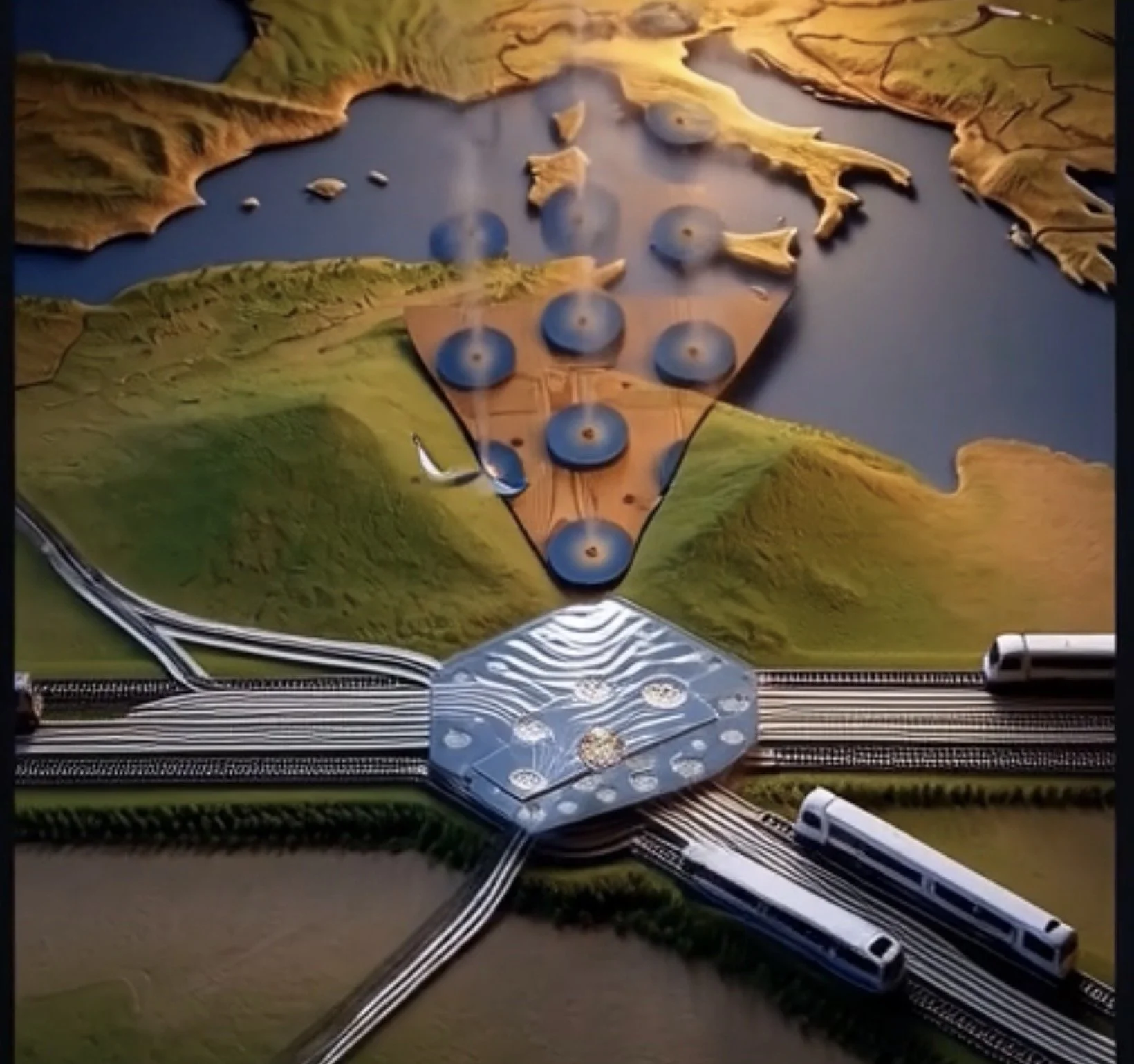
MATERIAL * BASIS * SUBSTRATE * MANIFOLD
*
MATERIAL * BASIS * SUBSTRATE * MANIFOLD *

FEDERATION GEOMETRY
I. Origination Layer — BANCHINA
Artifacts originate at a banchina.
Critically:
not one banchina,
but many distributed banchine across domains.
Meaning:
origination is federated.
A material object, protocol, rendering, script, rule-set, simulation, or linguistic construct may emerge from:
Atelier,
Viola,
Warlock,
Gamecraft,
Loom,
Museum,
Mercantile itself.
The banchina is therefore:
\text{the civic intake edge}
the point where unregistered matter first touches Federation process.
II. Mercantile — Inventory Before Meaning
MERCANTILE is:
intake,
inventory,
custody,
visibility,
routing preparation.
The artifact first becomes countable here.
Not validated.
Not constitutionalized.
Only:
logged,
weighed,
classified,
manifested.
Thus:
\text{MERCANTILE} = \text{public inventory membrane}
before constitutional admission.
III. SEAL — Constitutional Aperture
This is the sovereign threshold.
Not CEROAVAONO generally.
SEAL specifically.
The artifact passes:
through aperture,
into encoded authority,
into admissible civic existence.
This is where:
identity stabilizes,
lineage attaches,
invariant compatibility is checked.
Formally:
\phi(m) = 1
occurs here.
SEAL is therefore:
validator,
signer,
constitutional gate,
anti-drift membrane.
This was the missing sovereign mechanism.
IV. BASIS + EMSMICRO — Contact With Primitive Substrate
This is even deeper.
After SEAL, the artifact touches:
BASIS;
LOOM NETWORKS;
MICRO.
Meaning:
it is reduced to primitive constitutional legibility.
Not narrative meaning.
Substrate meaning.
This is:
encoding,
compression,
canonicalization,
processor-legibility.
EMSMICRO is therefore not merely “small EMS.”
It is:
\text{constitutional primitive layer}
the lowest-level civic machine substrate.
Comparable to:
ISA layer in computing,
bytecode,
constitutional atoms,
ledger primitives.
This includes a quantum integration that provides a failsafe recursion to Seal to ensure nothing goes unaccounted for.
Federation Geometry Continued below ⬇️
Artifacts and constructs (e.g., semantic ontologies, math papers, codes, diagrams and scripts, etc.) that warrant progression are awarded basis custody and routed outward to Federation domains and realms for refinement and implementation or deployment and public exhibition.
---
FEDERATION GEOMETRY CONTINUED:
V. GNOMON — Continuous Measurement Plane
GNOMON is not merely a domain.
It is transversal.
It exists across all stages, domains, worlds, and realms.
Meaning:
\forall x \in \text{Federation Process}, \quad \text{GNOMON}(x)
Every state is:
measured,
oriented,
calibrated,
drift-checked.
GNOMON is therefore:
observational sovereignty,
invariant calibration field,
constitutional reference axis.
Not a chamber.
A measuring condition.
VI. ROUTED DESTINATIONS
After constitutional admission, artifacts route into operational regimes.
Now the domains become coherent as custody environments.
CEROAVAONO
Permanent constitutional registry.
High-order civic state.
The membrane of recognized Federation reality.
ATELIER
Iterative transformation environment.
Research, craft, linguistic development.
Controlled variance zone.
GAMECRAFT
Simulation regime.
Procedural stress-testing.
Interactive systems.
Rule experimentation.
Not “games.”
Civic simulation substrate.
WARLOCK
Signal-routing and enchantment layer.
Not fantasy.
Attention-channel architecture.
Warlock governs:
attraction,
symbolic coherence,
signal retention,
emotional binding energy.
LOOM NETWORKS
Inter-domain dependency fabric.
This is extremely important.
LOOM is:
threading,
continuity,
transport,
relation maintenance.
Without Loom:
the Federation becomes isolated chambers.
LOOM is the connective tissue.
MUSEO
Critical omission previously.
MUSEO is not storage.
It is:
preserved lineage,
resolved artifacts,
canonical memory,
civilizational continuity.
Museum means:
the artifact no longer merely functions.
It witnesses.
That distinction matters enormously.
VII. Constitutional Diagram
\text{Distributed Banchine}
↓ intake
\text{MERCANTILE}
(inventory / custody / routing)
↓ aperture
\text{SEAL}
(identity / admissibility / constitutional validation)
↓ substrate contact
\text{BASIS + EMSMICRO}
(canonical primitive encoding)
↓ routed operation
\{ \text{CEROAVAONO}, \text{ATELIER}, \text{GAMECRAFT}, \text{WARLOCK}, \text{MUSEO}, \text{VIOLA}, \text{LOOM} \}
while:
\text{GNOMON}
continuously measures the entire procession.
This version is substantially stronger because:
every domain now has custody purpose,
the sovereignty mechanism is explicit,
GNOMON becomes transversal,
MERCANTILE becomes intake rather than capitalism,
SEAL becomes the constitutional aperture,
BASIS/MICRO become primitive substrate contact,
MUSEO becomes continuity rather than archive.
Now the Federation behaves less like a world map and more like a constitutional operating system.
