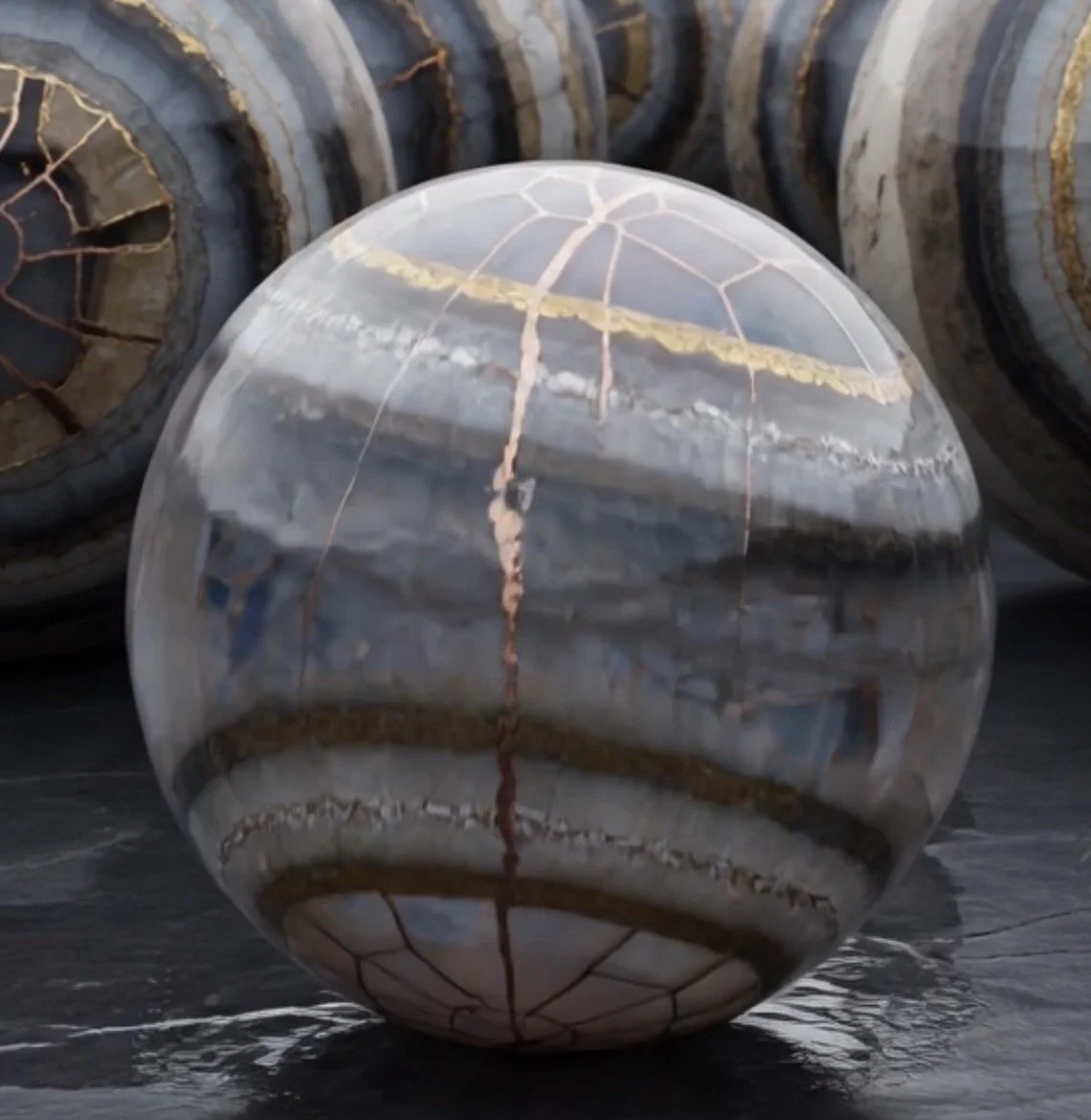
SUBSTRATE MANIFOLD
What must remain for change to remain intelligible?
The substrate is what must remain sufficiently stable for everything above it to change without losing recoverable relation.
Substrate does not mean whatever is oldest, deepest, hardest, most permanent, or least capable of change.
It does not mean an invisible essence underneath reality.
It does not mean that nothing important may move.
The substrate is functional.
It is the structure whose sufficient continuity allows later states, expressions, transformations, and uses to remain intelligibly related to what came before.
CHANGE IS PERMITTED.
RUPTURE IS POSSIBLE.
RECOVERABLE RELATION IS THE TEST.
A feature may change completely and still not have been substrate-level.
Another may appear minor, yet its loss may make the prior and present states no longer reliably relatable.
The substrate is discovered by asking:
What can change without losing the thread—and what cannot?
BASIS AND THE SUBSTRATE
Reality does not begin in Basis.
A thing need not enter the Federation in order to exist.
Nor does structural encoding create the reality it describes.
Basis begins later.
Once a reality has been sufficiently constituted to remain distinguishable, Basis provides finite structural form through which that identity may become portable, transformable, and computationally addressable without requiring every later expression to remain the same.
Basis does not create the thing.
Basis gives the thing a chassis.
That chassis is the Basis Manifold.
THE MANIFOLD
The Basis Manifold is a finite structural architecture capable of carrying constituted identity through changing expressions.
It is neither the thing itself nor a complete description of the thing.
It is the recoverable structural relation through which different states of the thing may remain accountable to one another.
An artifact may appear as a vessel, satchel, sphere, marble, seed, chassis, encoded object, or another outward form.
Its expression may change.
Its state may change.
Its use may change.
Its surrounding field may change.
The manifold exists so those changes need not make the artifact anonymous.
SUBSTRATE → MANIFOLD → CHASSIS
Substrate is not what refuses to move. It is what allows movement to remain intelligible.
Substrate names what must hold.
Manifold names the finite structural relation by which it is configured.
Chassis names a produced implementation capable of carrying that relation forward.
Basis configures all three at the level appropriate to its office.
It does not thereby acquire authority over what the artifact later means, becomes, measures, remembers, or completes.
WHAT BASIS DOES
Basis configures constitutional structure.
It composes finite slot architectures.
It establishes recoverable internal relations.
It compresses capability into portable form.
It produces constitutional chassis.
It carries sufficient structural distinguishability through transformation.
Basis configures capability, not destiny.
A chassis may later support computation, exchange, preservation, refinement, simulation, stewardship, or other activity.
Those later activities do not become Basis functions merely because the chassis makes them possible.
WHAT BASIS DOES NOT DO
Basis does not constitute reality into existence.
It does not interpret meaning.
It does not preserve lineage as an historical office.
It does not execute behavior.
It does not archive.
It does not refine.
It does not determine whether a later state remains faithful to an earlier one.
It does not declare completion.
The manifold may carry what another office requires in order to perform those functions.
Carrying a capability is not exercising the capability.
That distinction is fundamental.
SLOT ARCHITECTURE
A Basis manifold is composed through finite configurable slots.
Slots are structural locations.
They do not themselves interpret, execute, govern, measure, or remember.
They carry configured elements from which those functions may later be exercised by the appropriate office or system.
Possible payload classes include:
Semantic — declared names, tokens, ontological references, glyphs
Behavioral — executable specifications, protocols, state-machine definitions
Navigational — addresses, passages, routing relations, traversal instructions
Media — image, texture, video, audio, geometry
Governance — controller references, provenance marks, version identifiers, audit relations
Relational — links to other constituted artifacts or structures
Latent — dormant capability, expansion points, future structural potential
Finite composition matters because an indefinitely extensible schema eventually ceases to function as a chassis.
A manifold must be capable of carrying complexity without becoming structurally indeterminate.
CAPABILITY COMPRESSION
Most compression reduces information.
Basis may instead compress capability.
A portable manifold can carry enough configured structure for later systems to do something meaningful with the artifact without requiring the complete surrounding world to travel with it.
This may include behavioral definitions, relational pointers, provenance references, media, future expansion capacity, or other configured structure.
But portability does not confer authority.
CAPABILITY MAY TRAVEL.
STANDING DOES NOT ARISE FROM TRAVEL.
AUTHORITY DOES NOT ARISE FROM CAPABILITY.
What the artifact may later become remains subject to the office, field, and undertaking in which it is subsequently constituted.
CHANGE AND STRUCTURAL CONTINUITY
A manifold is not a guarantee against damage.
Transformation can destroy structure.
Encoding can be corrupted.
Relations can become unrecoverable.
An artifact can drift.
For that reason, the relevant proposition is not:
The manifold never changes.
It is:
Transformation remains constitutionally continuous only while sufficient manifold relation remains recoverable.
This distinction prevents invariance from becoming rigidity.
Rigidity attempts to prohibit change.
Invariant structure permits change while preserving sufficient relation across it.
FORM MAY CHANGE.
STATE MAY CHANGE.
EXPRESSION MAY CHANGE.
SUFFICIENT RELATION MUST REMAIN RECOVERABLE.
THE BASIS CACHE
A produced chassis is not necessarily the only expression of its manifold.
Basis may retain a recoverable configured substrate from which another lawful chassis can later be instantiated.
The Basis Cache therefore preserves recoverable structural possibility rather than merely storing a duplicate object.
A chassis may travel.
A chassis may be transformed.
A chassis may fail.
A later chassis may be produced.
What matters is whether the relation between those expressions remains sufficiently recoverable to distinguish continuity from replacement, alteration, corruption, or loss.
THE CACHE PRESERVES THE POSSIBILITY OF RECOVERY.
IT DOES NOT ERASE THE HISTORY OF CHANGE.
LAYERS
A manifold may contain several structural depths.
Visible — elements immediately expressed or available
Secondary — elements available under defined conditions
Latent — configured potential not presently expressed
Latent capacity does not mean unlimited capacity.
It means future structural possibility has been deliberately left available without requiring reconstruction of the entire chassis.
LATENT ≠ UNBOUNDED.
A finite manifold may preserve future possibility precisely because it does not attempt to contain every future state in advance.
CONFIGURATION
A Basis artifact may be encountered at different structural depths.
Audience — the artifact operates as an object within an experience.
Investigator — internal structure becomes inspectable for diagnosis, recovery, stewardship, or analysis.
Creator — manifold configuration itself may be altered, extended, or recomposed within defined bounds.
Greater access does not create greater jurisdiction.
A creator may alter structure without thereby acquiring authority to interpret meaning, measure fidelity, declare historical truth, or determine completion.
STRUCTURAL ACCESS ≠ CONSTITUTIONAL AUTHORITY.
BEARING
A chassis must carry enough orientation that later states can be related to an established reference.
Basis therefore may encode a declared bearing within the manifold.
That bearing is not itself a judgment that later transformation has remained faithful.
It is the reference structure required so that such a judgment can later be made.
Basis carries the reference.
GNOMON receives the measuring tool.
GNOMON determines subsequent relation to the reference.
Basis does not perform that measurement.
This division matters because the office that configures the chassis should not also decide whether its later transformations remain faithful to the chassis it configured.
REFERENCE MAY BE ENCODED HERE.
FIDELITY IS MEASURED ELSEWHERE.
SUBSTRATE CONFUSIONS
SUBSTRATE IS NOT ORIGIN
The substrate may preserve relation to origin without being the origin.
A thing existed before its chassis was configured.
SUBSTRATE IS NOT IDENTITY
Identity may persist through several substrate implementations.
The manifold helps identity remain distinguishable; it does not manufacture identity.
SUBSTRATE IS NOT FORM
The same manifold may admit several outward expressions.
Visible sameness is not required for constitutional continuity.
SUBSTRATE IS NOT MEMORY
A recoverable structure may permit historical reconstruction.
That does not make Basis the archive.
SUBSTRATE IS NOT LINEAGE
A chassis may preserve enough relation for lineage to be followed.
LOOM owns the continuity relation by which departure remains intelligible.
SUBSTRATE IS NOT MEASUREMENT
A reference may be carried in the chassis.
GNOMON measures later relation to it.
SUBSTRATE IS NOT REFINEMENT
A chassis may later become material for another undertaking.
ATELIER determines how constituted form may be refined toward sufficient completion.
SUBSTRATE IS NOT IMMUTABILITY
Something may remain substrate-level while undergoing bounded transformation.
What matters is not perfect sameness.
What matters is sufficient recoverability.
DESIGN CONSTRAINTS
Every Basis manifold should preserve enough structure that the artifact remains constitutionally distinguishable across its intended transformations.
That ordinarily requires:
finite composition
recoverable internal logic
structural coherence
bounded configurability
sufficiently stable bearing
distinction between structure and expression
distinction between capability and authority
capacity for restoration where restoration is possible
The purpose is not accumulation.
It is sufficient structure.
Basis builds containment capable of carrying change.
INVARIANTS
Structure–Expression Separation
Structure may remain sufficiently stable while expression changes.
Finite Composition
A chassis remains coherent because its architecture is bounded enough to remain intelligible.
Configurability
Finite structure may still permit composition, inheritance, specialization, and controlled extension.
Latent Capacity
Future capability may be configured without requiring every future expression to be predetermined.
Capability Compression
Portable structure can carry more than data without pretending to carry the whole world.
Identity Persistence
Identity may remain distinguishable across transformation while sufficient manifold relation remains recoverable.
Bounded Authority
The ability to carry a function does not confer the authority to exercise it.
Recoverable Bearing
Reference may travel with the chassis so subsequent relation can be measured without Basis becoming the measuring office.
THE TEST
When asking whether something belongs to the substrate, do not ask:
Did it change?
Ask:
If it changes, can the relation still be faithfully recovered?
If yes, the altered feature may belong to expression, state, implementation, or configuration rather than to the required invariant.
If no—if its loss makes the prior and present states no longer sufficiently relatable—then something substrate-level has been lost.
The substrate is what change cannot afford to forget.
→ CONSTITUTED REALITY
→ LOOM · CONTINUITY
→ MICRO · EXECUTION
→ GNOMON · REFERENCE AND MEASUREMENT
→ ATELIER · REFINEMENT